
 Willem Veldhuyzen
 No Comments
 Oct 13, 2026
*Update 10-14-2026
Filing taxes without records is possible because a past due tax return can usually be rebuilt from an IRS transcript, bank statements, payroll records, and payer duplicates even when the original W-2 or 1099 is gone.
Missing tax papers does not prevent you from filing a return.
The wage and income transcript from the IRS lists income payers already reported to the IRS, giving a reliable starting point for reconstructing a prior-year return using that specific year’s forms and rules.
When people search for how to file taxes without records, they usually mean one of five problems: lost W-2s or 1099-MISC forms, no receipts, closed bank accounts, a move that broke the paper trail, or several years of back taxes piling up.
This guide shows how to rebuild income, deductions, and filing history with IRS transcripts, bank data, and third-party statements so you can file with support instead of guesses.
Key Takeaways
- You can file taxes without records by using IRS transcripts, bank statements, and third-party documents to rebuild income and deductions.
- Missing forms like W-2s or 1099s don’t stop you from filing; you can often recreate necessary data from alternate sources.
- Filing late is better than not filing at all, as it helps avoid escalating penalties and potential IRS collection actions.
- Focus on requesting the right IRS transcripts first to ensure you have a clear starting point for your return.
- Be aware of common mistakes like double counting income or using the wrong tax year’s forms, which can complicate your filing process.
Table of Contents
- What “No Records” Really Means (And Why You Should File Anyway)
- Start With the IRS: Get the Right Transcripts
- Recreate Income When Forms Are Missing
- Reconstruct Deductions and Credits Without Receipts
- Choose the Right Filing Path: Current Year vs. Prior Years
- Minimize Penalties and Prevent Collections
- Worked Example: Rebuilding a Return With No W-2s and No Receipts
- Common Mistakes to Avoid When Filing Without Records
- FAQs
What “No Records” Really Means (And Why You Should File Anyway)
“No records” rarely means zero evidence exists.
A past due tax return can usually be rebuilt from a tax transcript, payroll records, bank statements, lender forms, and payer duplicates, even if the original W-2, 1099-NEC, or 1099-MISC is gone.
Filing after a missed deadline still matters even when payment is impossible.
The IRS late-filing penalty is typically 5% of unpaid tax per month, capped at 25%, while the late-payment penalty is usually 0.5% per month, which means delay gets expensive faster when no return is on file.
An unfiled return also invites a Substitute for Return, or SFR. An SFR often overstates what you owe because the IRS builds it from income documents it received, but usually does not include business expenses, dependents, or many credits you may legally claim.
That is why filing late is usually better than waiting for perfect paperwork. If you need context on filing late taxes or the penalty for filing late taxes, the numbers make the decision clear.
Important Deadlines and the Refund Window
The three-year rule matters if you expect money back.
You generally must file within three years of the original due date to claim a refund or certain credits, so waiting too long can turn a refundable year into a permanent loss.
Interest and penalties usually keep running until you file and pay or arrange payment. That timing issue means an old return is not just an administrative problem; it becomes a growing balance.
Start With the IRS: Get the Right Transcripts
Your first move should be the IRS, because transcripts show what payers already reported under your Social Security number.
That matters because transcript-based filing reduces mismatch notices and gives you a cleaner starting point than memory.
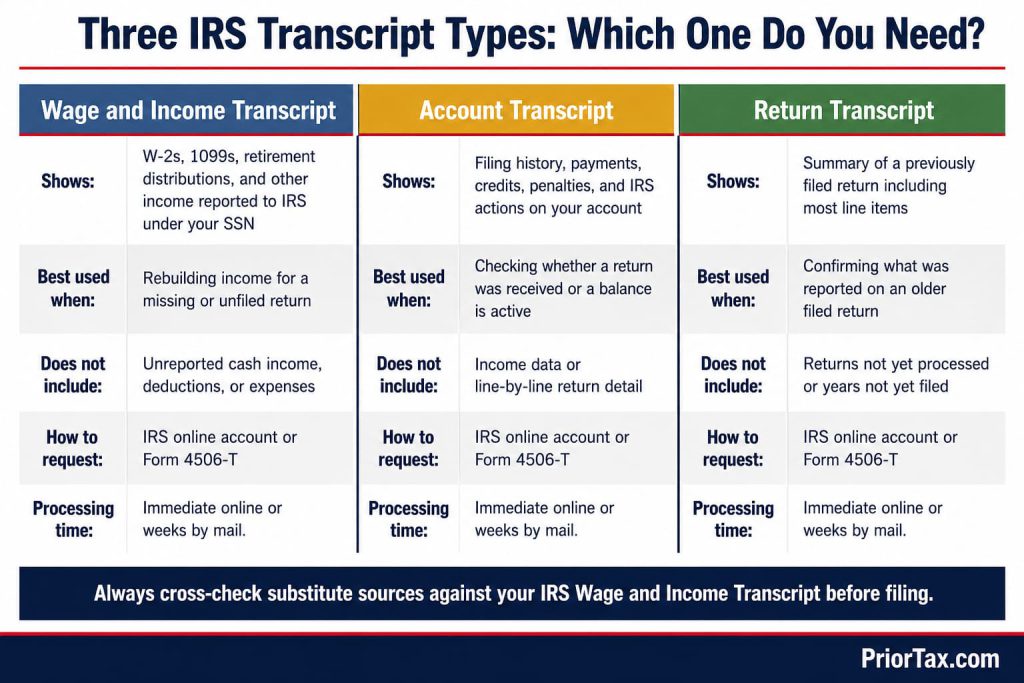
Three transcript types do most of the work.
The Wage and Income Transcript lists W-2s, 1099s, retirement distributions, and other reported income; the account transcript shows filing status history, payments, and IRS actions; the return transcript summarizes a previously filed return.
Use the correct tax year every time.
A mismatch between a 2022 transcript and a 2023 return can trigger avoidable IRS correspondence, even when the numbers themselves are real.
Identity verification can limit access. The fastest route is an IRS online account, but some taxpayers need mailed access codes or identity checks before transcripts become available.
How to Request Transcripts (Fastest to Slowest Options)
The fastest option is the IRS online account. If you can verify identity, you can usually view or download transcripts immediately.
Mail works when online access fails. Form 4506-T or the IRS transcript-by-mail option can request records, but delivery takes longer and slows any urgent filing plan.
What Transcripts Do Not Show
Transcripts do not capture everything you need to prepare an accurate return. They usually will not show deductible basis, a mileage log, cash tips that were never reported by a payer, or the details behind business expenses.
Some forms also post late or not at all if the payer failed to file properly. Cross-check transcript entries against pay stubs, bank deposits, and prior account records before treating the transcript as complete.
Recreate Income When Forms Are Missing
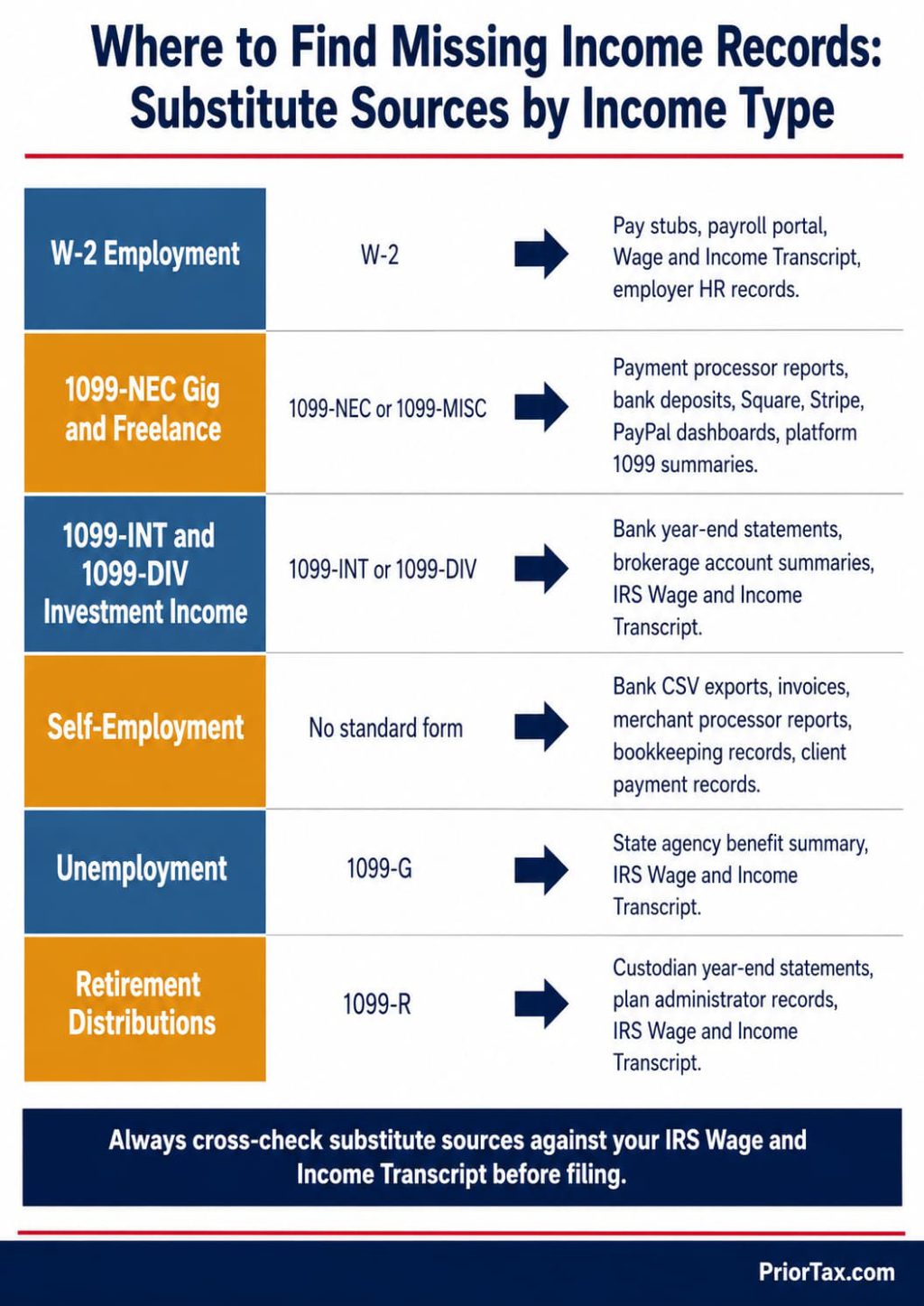
Income reconstruction starts with alternate proof, not guesswork. Pay stubs, payroll portals, state wage statements, invoices, bank deposits, and payment processor reports often rebuild enough detail to prepare a return that matches what the IRS can verify.
Self-employment income needs a separate process.
If you drove for apps, freelanced, sold services, or received a 1099-NEC, rebuild gross receipts from bank statements, PayPal, Stripe, Square, marketplace dashboards, and invoice logs.
Multiple income streams create the biggest error risk. Interest, dividends, unemployment, retirement distributions, and side-gig payments often arrive from different institutions, so one missing form can hide a taxable item that later triggers an underreporting notice.
Keep a reconstruction file as you work. A dated spreadsheet showing assumptions, source documents, and unresolved gaps gives you a defense if the IRS later asks how you calculated self-employment income.
If a W-2 or 1099 Is Missing
Ask the employer or payer for a duplicate first. If that fails, use the Wage and Income Transcript and make sure the employer name, EIN, and amount match before entering anything into tax software.
If You Have Cash or Mixed Deposits
Separate personal transfers from real income before totaling deposits. A simple spreadsheet with date, source, amount, and category prevents double-counting and gives you a cleaner audit trail.
Reconstruct Deductions and Credits Without Receipts
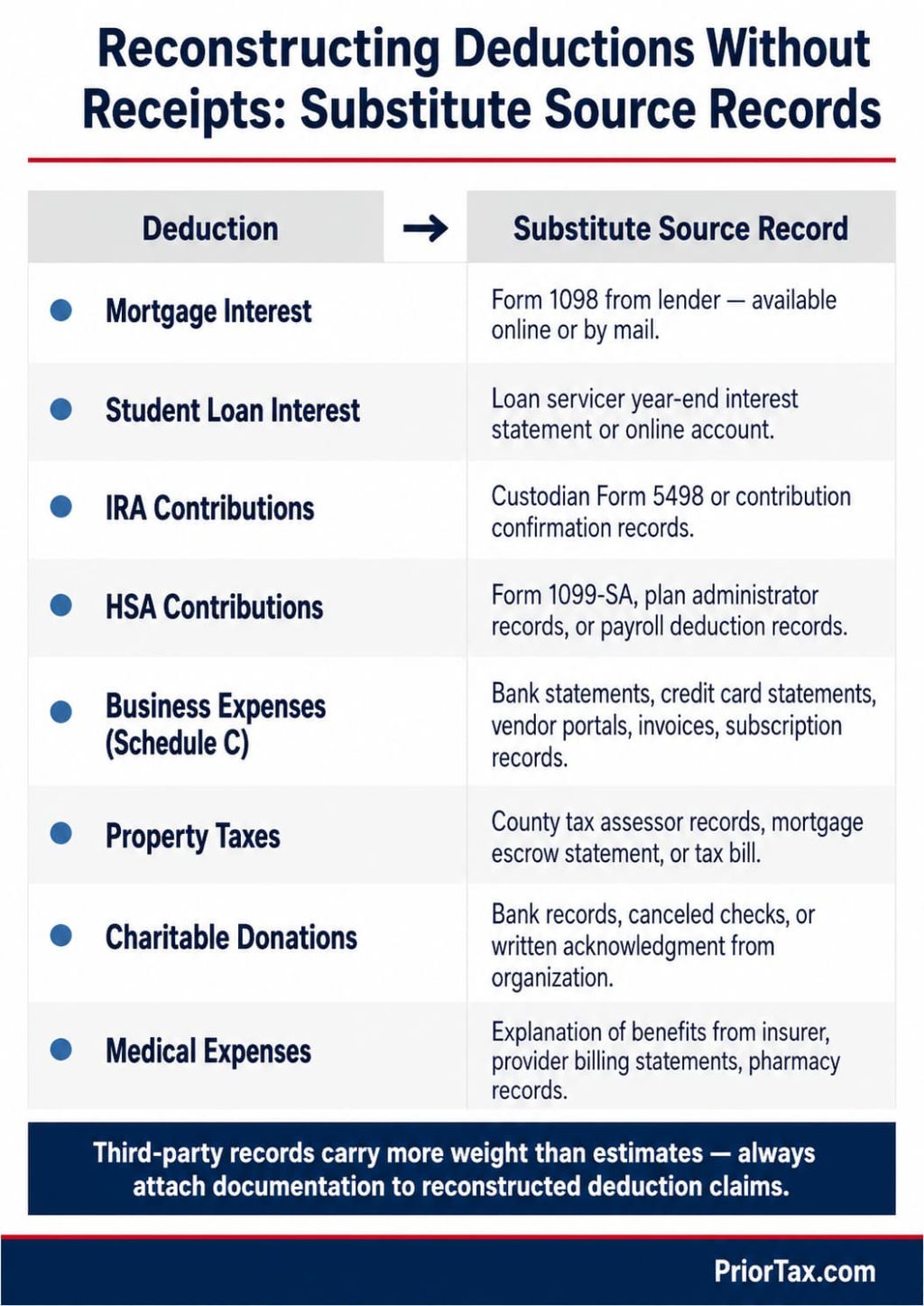
Missing receipts do not erase every deduction. Third-party records often recover high-value items such as student loan interest, IRA contributions, HSA contributions, mortgage interest, property taxes, and some tax credits tied to lender or school reporting.
Credit card statements and bank statements help rebuild business spending when receipts are gone.
That evidence is strongest when paired with vendor portals, invoices, subscription histories, or account emails that explain what the charge actually bought.
A reasonable estimate is not the same as a wild guess.
Tax law allows estimation in limited situations, but unsupported round numbers invite scrutiny, especially when the deduction appears large relative to income.
Documentation rules tighten around credits.
Child Tax Credit, Earned Income Tax Credit, and education benefits depend on exact income, dependent, and enrollment facts, so missing support can turn a valid claim into a denied one.
Business Expenses: What You Can Rebuild From Statements
Bank and card records can usually support supplies, software, advertising, processing fees, and the business portion of phone or internet costs.
The Internal Revenue Service expects categories to line up with Schedule C, so classify transactions by tax line, not by whatever the bank called them.
Travel needs more than a charge amount.
Mileage can be rebuilt from calendars, repair records, appointment books, and map history, then summarized in a mileage worksheet that explains business purpose and dates.
Credits That Depend on Documentation
Education credits usually require Form 1098-T plus proof of qualified expenses.
Dependent-related credits require names, Social Security numbers, relationship, residency, and support facts that match IRS rules.
Choose the Right Filing Path: Current Year vs. Prior Years
When several returns are missing, file the oldest year first. That order reduces compounding issues, helps with carryforwards, and gives the IRS a clearer sequence for resolving back taxes.
Use the form set for the exact year you are filing.
Tax brackets, credits, and deduction rules change annually, so using current-year software for an older return can produce a technically neat but legally wrong result.
Older returns often cannot be e-filed through standard consumer software.
Paper filing may be required, and if you already received an IRS notice, follow that notice first because it may set a deadline or special mailing address.
If you are unsure how far back to go, review years you can file back taxes and assess whether any year still falls inside the refund window.
If the IRS Already Filed an SFR for You
An SFR is not always final.
You can usually replace it by filing an original return that claims the deductions, filing status, and credits the IRS did not include.
Speed matters once an SFR balance posts. Collections can move faster after assessment because the tax is no longer just “missing”; it becomes an active debt.
Where and How to File a Past-Due Return
File a past-due return using that year’s instructions and IRS address rules. If paper filing is required, send it by certified mail with return receipt and keep copies of everything you mailed.
Minimize Penalties and Prevent Collections
File as soon as possible, even if payment is out of reach.
Filing stops the late-filing penalty from growing, while nonresponse can move a tax problem from paperwork into collections.
The IRS usually escalates in stages: notices first, then possible liens, levies, or wage garnishment after extended nonresponse. That sequence matters because early action preserves more options and costs less than waiting for enforcement.
Respond to every IRS letter.
Automated systems assume silence means unresolved liability, which is why a missed notice can do more damage than a small initial balance.
If you need help with prior years taxes or want to understand what happens if you don’t pay taxes on time, the main principle is simple: file first, resolve payment second.
Extensions and Payment Arrangements
Form 4868 extends filing time for a current-year return, but not time to pay. After filing, Form 9465 or an IRS online payment plan can help spread the balance over time.
When to Consider Professional Help
Some cases justify expert help immediately. Multiple missing years, heavy self-employment reconstruction, large balances, or an IRS notice usually call for a CPA, Enrolled Agent, or tax attorney.
Worked Example: Rebuilding a Return With No W-2s and No Receipts
Assume a taxpayer had two employers, one 1099 gig, and no receipts for side-business expenses.
The clean workflow is transcripts first, then bank statements, then categorizing income and expenses, then confirming totals before filing.
The wage and income transcript identifies both employers and the gig payer.
Bank CSV exports fill in deposits, while card statements rebuild software fees, supplies, and advertising costs that belong on Schedule C.
Save the support file in one folder.
Keep transcript PDFs, bank exports, payer emails, screenshots from payment platforms, and an assumptions sheet explaining any reconstructed totals.
If the IRS later sends a mismatch notice, often similar to a CP2000 concept, compare the notice to your filed return and source records before replying.
Many mismatch cases come from omitted 1099s or duplicate entries, not fraud.
Reconstruction Checklist (One Page)
Income records should include wage and income transcript, pay stubs, 1099 platform reports, and bank deposits.
Deduction records should include card statements, 1098 or 1099 forms, charitable summaries, and mileage reconstruction notes.
Common Mistakes to Avoid When Filing Without Records
The wrong tax year’s forms can sink an otherwise careful return.
Prior-year filing requires prior-year law, and software shortcuts often create errors that look small until the IRS compares them to transcript data.
Double counting income is common when taxpayers enter transcript totals and then also report the same deposits from bank records.
That mistake inflates taxable income and can make a reconstructed return worse than the missing-paper problem it was meant to solve.
Overstated deductions create a second trap.
Personal spending mixed into business categories, unsupported Schedule C losses, and invented round-number write-offs pull attention because they do not fit the income pattern the IRS already sees.
Waiting because you cannot pay is another expensive mistake.
The filing problem and the payment problem are separate, and the first one usually hurts faster.
Red Flags That Increase Audit or Notice Risk
Large Schedule C losses without support, missing 1099 matching, and income that appears inconsistent with spending patterns often trigger questions.
Credits claimed without eligibility documents, especially dependent or education claims, also raise notice risk.
FAQs
Can you file taxes on SSI disability?
Yes. SSI itself is generally not taxable, but you may still need to file if you had other income or if filing lets you claim refundable credits.
What triggers red flags to IRS?
Common triggers include mismatches with W-2 or 1099 data, unusually high deductions compared with income, repeated business losses, and credits claimed without proof. Most red flags start with math or document inconsistency.
Is autism considered a disability for taxes?
It can be, depending on the facts and documentation. Tax treatment usually depends on dependent status, support tests, and whether IRS rules for a specific credit or benefit are met.
What is the 3 year rule for the IRS?
The common three-year rule means you generally must file within three years of the original due date to claim a refund. After that window, the refund may be lost even if the return is later accepted.
Filing without records is a reconstruction project, not a dead end. If you work from IRS transcripts, rebuild missing numbers from third-party evidence, and file the correct year in the correct order, you can usually turn incomplete paperwork into a defensible return.

About The Author
Willem Veldhuyzen is the founder and president of PriorTax and an IRS-enrolled professional. PriorTax has been in business for 20 years since 2006, and he’s hands-on with tax calculations, software updates, and customer support.

Categories: